Europe
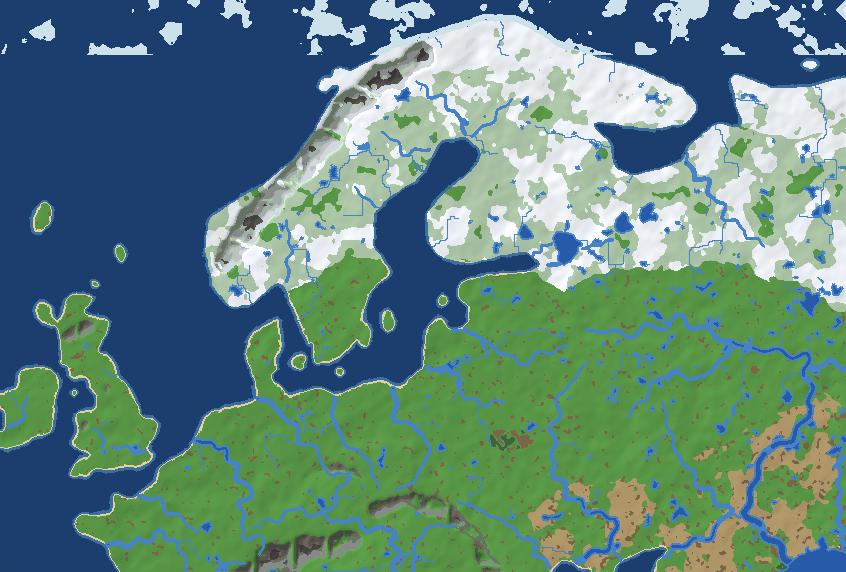
Europe is a land of the persistent worlds drawn after the real continent, from the Atlantic shore to the Urals and the northern ice. Its cold north is hard country, but its temperate heartland is good farming ground, and its coal and calamine make it a natural home for industry.
At a glance
| Climate | Tundra and taiga in the north, temperate forest and fields in the middle, dry steppe in the south-east |
| Local time | 1 hour ahead of the reference time; northern seasons |
| Rich in | Coal and calamine (zinc); cinnabar is twice as common as elsewhere |
| Peoples | Northmen, Gaels, Hellenes and Latins |
| Neighbours | Asia on foot to the east; the other lands by sea or air |
| Coasts | West and north |
Getting there
- On foot from Asia. Walk off the west edge of Asia in its northern part and you come out on Europe’s east edge. Walk off Europe’s east edge to go back (see Walking to a neighbouring land).
- By ship. Europe’s coasts face the open sea to the west and north. Sail from any other land’s coast and choose Europe from the voyage list (see Sailing between the continents).
- By plane. Fly from any other land (see Flying to another continent).
The land
- The north is snow, tundra and taiga across the northern peninsulas and the great plain. Winters are long and bitter there: dress for the cold and keep a fire (see Winter & Long Rounds).
- The middle is temperate forest and open ground, crossed by long rivers. It has the mildest weather and the best soil.
- The south-east turns to dry steppe and a little desert towards the Caspian.
- Bogs and marshes lie along the rivers and the low coasts.
- Mountains stand in the south and along the northern peninsula. Mined-out mountain floor keeps giving stone and regrowing ore seams (see Old mountain floor and ore seams).
- No diving. There is no seabed level under the sea, so submarines stay on the surface, and aircraft carriers and freighters with a hold below the waterline need Gaia.
Resources
- Coal and calamine turn up twice as often as usual, and cinnabar twice as often too (see Mercury).
- Iron is found at the usual rate. Copper, tin, silver, gold and gems are scarcer than usual, and saltpeter, sulphur, lead and bauxite much scarcer, so trade or travel for them (see Each continent’s ores).
- Oil: springs on land run dry here. Drill offshore instead (see Offshore drilling rigs).
- No rubber trees and no mulberries for silk.
Peoples and languages
Someone born in Europe belongs to the people of the climate they were born in: Northmen (Old Norse) in the tundra and taiga, Gaels (Gaelic) in the temperate lands, Hellenes (Greek) on the coasts and Latins (Latin) in the dry south. See Peoples and Languages.