Boats & Ships
Anything that floats is built from the crafting menu's vehicle parts section. Pick the boat that fits your needs:
| Boat | Best for | Crew | Propulsion |
|---|---|---|---|
| Raft | Crossing a river or lake early on | 1 | Paddling (direction keys) |
| Sailing outrigger | Cheap travel along a coast | 2 + 1 cargo | Wind |
| Motor outrigger | Fast, wind-free travel | 2 + 1 cargo | Engine |
| Rigid hull inflatable boat (RHIB) | Sturdier motorboat with a bigger engine | 2 + 1 cargo | Engine |
| Modular ship | Carrying a crew, cargo and guns | As many as fit | Masts and sails, or an engine |
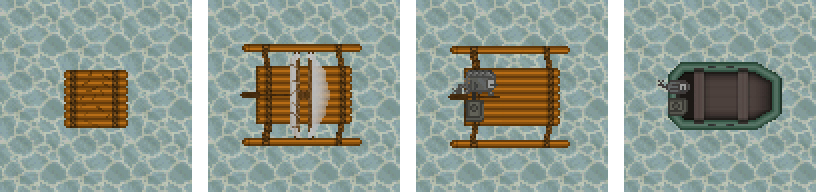
From left to right: raft, sailing outrigger, motor outrigger, RHIB. Offline render using Civ13 sprites, not a live screenshot.
Research and materials
| Part | Cost | Tech tree node | Legacy research |
|---|---|---|---|
| Raft | 10 wood logs | Carts | Industrial 22 |
| Outrigger boat frame | 22 planks | Wagons & Ships | Industrial 22 |
| Small sail | 15 cloth or 15 wool | Wagons & Ships | Medical 22 |
| Wood ship frame | 4 planks per tile | Wagons & Ships | Industrial 41 |
| Ship rudder control (the wheel) | 10 planks | Wagons & Ships | Industrial 41 |
| Ship mast | 15 planks | Wagons & Ships | Industrial 41 |
| Light ship rudder axis (1200 weight) | 25 planks | Wagons & Ships | Industrial 41 |
| Ship rudder axis (2500 weight) | 45 planks | Wagons & Ships | Industrial 55 |
| Steel ship frame | 2 steel per tile | Wagons & Ships | Industrial 97 |
| Rigid hull inflatable boat frame | 22 planks | Automobiles | Industrial 175 |
| Engine maker | 5 iron | Machined Tools | Industrial 115 |
| Fuel tanks | 2-36 steel | Combustion Engine | Industrial 120 |
The small sail is in the cloth (or wool) crafting menu, not in vehicle parts. Engines are built with the engine maker; see Engines for engine types and the fuel each one burns.
Where to build
- Boats only move onto water: shallow or deep water, swamp water and flooded trenches. Ice and dry land stop them.
- You can't craft while standing in deep water, so build at the shoreline or in the shallows, facing open water.
- Rafts and finished boats can't be pushed or pulled, so build them where you mean to launch them.
- A flooded trench is navigable. Dig a channel from a lake or the sea to a sheltered building spot, or around a ship to give it room to turn.
Raft
- Craft a raft from 10 wood logs at the water's edge.
- Drag yourself onto the raft to climb aboard. A raft carries only you.
- Paddle with the direction keys. Each step must land on water.
- Click the raft to get off.
On some maps the open sea is closed to rafts, and you will be told you can't go further. To recover the wood, hit the raft with a hammer: you get 5 planks and a rope back.
Outriggers
An outrigger starts as an outrigger boat frame (22 planks). Making a boat frame needs a Crafting skill of 1.35, and you name the boat when you craft it. The frame then becomes either a sailing boat or a motorboat. You can't turn one into the other later.
Sailing outrigger
Click the frame with a small sail. After a few seconds it becomes a sailing outrigger.
- Drag yourself onto the boat. The first person aboard is the helmsman and takes the rudder and sail control in hand, so keep a hand free. A second person can ride as a passenger.
- Press Z (use the item in your hand) to hoist the sails, and press it again to take them in.
- The boat sails the way you face. Turn with the direction keys.
- Speed depends on the wind. See Sailing and the wind.
- If the next tile isn't water, the boat runs aground and the sails come down.
Hit a sailing outrigger with a hammer to take it apart. You get the sail and 10 planks back.
Motor outrigger
- Build an engine of 100 to 400 cc with the engine maker. Smaller or larger engines are refused. See Boat engines for which types fit.
- Drag the engine onto the frame.
- Click the frame with a fuel tank of up to 150 units. The 120u small fuel tank and the bike tanks fit. The boat is finished as soon as the tank goes in.
- Fill the tank by clicking the boat with a barrel or other container of the fuel your engine burns. Examine the boat to see how much fuel is left.
Rigid hull inflatable boat
The RHIB is built exactly like a motor outrigger, from a rigid hull inflatable boat frame (22 planks, the same Crafting skill 1.35), but it is much sturdier and takes bigger parts:
- An engine of 150 to 600 cc. See Boat engines for which types fit.
- A fuel tank of up to 200 units, such as the 180u medium fuel tank.
Boat engines
Motorboats take any engine made with the engine maker. The steam engine doesn't fit, because it needs a separate furnace. The type decides which fuel the boat burns. Some types have a minimum size, which rules out the smaller outrigger sizes:
| Engine type | Smallest you can build | Outrigger (100-400 cc) | RHIB (150-600 cc) |
|---|---|---|---|
| 2-stroke gasoline | 49 cc | 100-400 cc | 150-600 cc |
| 4-stroke gasoline, high-efficiency 4-stroke, ethanol-gasoline | 80-100 cc | 100-400 cc | 150-600 cc |
| Hot bulb, Hesselman | 200 cc | 200-400 cc | 200-600 cc |
| Turbine | 250 cc | 250-400 cc | 250-600 cc |
| Diesel, biodiesel | 300 cc | 300-400 cc | 300-600 cc |
An engine of 300 cc or more gives the fastest boat, so a 300-400 cc engine is a good choice for either hull.
Driving a motorboat
These controls work on both the motor outrigger and the RHIB. See Hotkeys if you use different keys.
| Action | How |
|---|---|
| Board | Drag yourself onto the boat. The first person aboard drives and takes the boat rudder in hand. A second person rides along. |
| Start the engine | Press Z with the rudder in hand. The tank must have fuel. |
| Go and speed up | Press Z again for first gear, and again to speed up (three speeds). |
| Slow down and stop | Press C. |
| Steer | The boat drives the way you face. Turn with the direction keys. |
| Turn off and get off | Click the boat with the rudder. The first click shuts the engine off and the next one gets you off. |
A bigger engine moves faster: engines of 300 cc or more are quickest, and engines of 200 cc or more beat the smallest ones. The boat stops when the next tile isn't water.
Cargo: each outrigger or RHIB can carry one loose structure, such as a crate or a small cannon. Drag it onto the boat to load it. Click the boat to unload it beside you.
Modular ships
Ships are built tile by tile out of frames, like modular tanks, but they float. A ship can be at most 5x5 tiles (25 frames) and should be a rectangle. Every ship is assembled facing north, so the top row of frames is the bow.
 |  |  |  |
| 1 | 2 | 3 | 4 |
Building the hull
-
Lay out wood ship frames (4 planks each) or steel ship frames (2 steel each) in the shallows, one per tile. You can fix a frame in place with a wrench so nobody pushes it out of line.
-
Add the walls before assembly, because a frame stops taking walls once it joins a ship. Click a wood frame with wood logs, or a steel frame with steel. Then pick a side, a thickness from 1 to 50 mm and a type:
- Wall: solid and impassable, with the most health.
- Crenelated wall: a wall with a gap you can walk through. Use it where the crew boards and leaves.
- Open window: a weaker wall section, mostly for looks.
A wall on the left side costs 1 log or sheet per 5 mm of thickness. The other sides cost 1 per 10 mm.
Fitting it out
-
Place the ship rudder control (the wheel) on one of the frames. The wheel must be on the ship before you assemble it, or it won't be connected.
-
Give the ship a way to move:
-
Sail: place one or more ship masts on frames and click each mast with a small sail. The mast sprite is larger than one tile, so it looks offset; this is how it sits when the ship faces north:

-
Engine: place an engine on a frame and connect a fuel tank to it by clicking the engine with the tank (see Engines). Steel ships in later ages usually run on engines.
A ship can carry both masts and an engine.
-
Assembling the ship
-
Build a ship rudder axis on the top-left (north-west) frame. There must be no frame to its west or north.
- The light axis carries up to 1200 weight.
- The heavy axis carries up to 2500 weight.
Both axes are made of planks, even for a steel ship.
-
Click the axis, confirm, and name your ship. Every frame, mast, engine, fuel tank and wheel in the 5x5 square running east and south of the axis joins the ship.
If you forgot a mast, drag it onto one of the ship's frames afterwards. Engines can be added the same way. A wheel can only be connected during assembly.
 |
A steel ship, built from steel ship frames. |
Weight
Examine any frame of the ship to see its current weight. Every frame, every object aboard and every person adds to it.
- Under sail, the ship won't move if it weighs more than the axis can carry.
- Under engine, it also stalls if it weighs more than twice the engine's power. An engine of 12,000 to 15,000 cc is enough for almost any ship.
At the helm
Stand next to the wheel and click it to open the helm. A ship starts with its anchor down.
| Control | What it does |
|---|---|
| Turn Left / Turn Right | Turns the ship a quarter turn. This only works while moving, at most once every 3 seconds, and fails if another ship or obstacle is in the way. |
| Reverse | Sails backwards (astern) on the same heading. Click again to go forwards. |
| Anchor | Drops or lifts the anchor. A ship can't move with the anchor down, and dropping it stops the ship at once. |
| Sails | Hoists or takes in the sails on every mast. |
| Engine | Turns the engine on or off. |
| Increase / Decrease Speed | Engine speed: slow, half and full. Decreasing from slow stops the ship, and decreasing again turns the engine off. |
To set sail: hoist the sails, then lift the anchor.
Under engine: turn the engine on, lift the anchor, then increase speed.
To stop, drop the anchor or take in the sails. With an engine, decrease the speed to zero. Under engine, the light axis is quicker than the heavy one.
Hazards
- A ship stops when its bow meets land, ice, another ship or a solid obstacle it can't break.
- A ship weighing 400 or more smashes through most solid objects in its path. At 800 or more it runs over anyone in the way, and lighter ships still hit them hard. Keep swimmers clear of the bow.
- Explosions can break or destroy masts. A ship with a broken mast, or a mast without a sail, won't sail.
Sailing and the wind
Sails depend on the wind. The Status tab shows the current wind, for example "A moderate Northern breeze". The game also announces in chat when the wind changes. The wind is named after the direction it blows from, so a northern wind pushes ships south.
| Course | Speed |
|---|---|
| With the wind behind you (northern wind, heading south) | Full speed |
| Across the wind (northern wind, heading east or west) | About 2.5 times slower |
| Into the wind (northern wind, heading north) | About 10 times slower |
A stronger wind is faster. A gale is the quickest, and with no wind at all sails barely move. These rules apply to both sailing outriggers and sailing ships. If you need to go upwind, an engine is the reliable choice.