North and South America
North America and South America are the main persistent lands. Each is its own world on its own server, drawn loosely after the real continents, and the two meet at the isthmus. New characters start in North America, on a random patch of safe open ground, which can be one of the islands. South America is a walk away: head south down the isthmus and keep going. Both lands start in the Stone Age, and every recipe is studied from a book first; Your First Day walks a new character through it.
Gaia lies across the sea to the east: build a ship and sail there from either east coast (see Sailing between the continents, or fly there: Flying to another continent). The other lands are listed in Travel Between Lands.
The two lands
| North America | South America | |
|---|---|---|
| Size | 1132 x 920 tiles, about 300,000 tiles of land | 848 x 1224 tiles, about 400,000 tiles of land |
| North | Tundra and sea ice, then a wide belt of taiga | The isthmus, joining North America |
| West | Mountain chains with passes through them, dry plains and a desert in the south-west | A mountain chain down the whole coast, with a coastal desert and a high, cold plateau |
| Middle and east | Temperate forest, the great lakes and a long river system draining the middle | Jungle along the great river basin, then savanna and dry scrub |
| South | Jungle down the narrowing land to the isthmus, and islands in the warm sea | Temperate grassland and a cold cape with ice at the bottom |
Each land is a single surface level with open sky above it.
- No caves below. Mountains are rock you mine at ground level, so neither land has an underground level and you cannot dig down.
- One upper floor. A roof carries one floor above it, and planes fly on the air level over the land.
- No diving. There is no seabed level under the sea, so submarines stay on the surface, and aircraft carriers and freighters cannot be built here. Those need Gaia.
- Wild plants and animals grow from each area’s climate, so the jungle, the taiga and the desert each have their own trees, bushes, crops and wildlife. In the savanna and the desert, the fertile banks along the rivers can be ploughed, and desert scrub bushes give desert seeds.
- Mountains keep giving. Mined-out mountain floor can still be worked with a pickaxe for stone, and ore seams in it come back over time (see Old mountain floor and ore seams).
Map layout
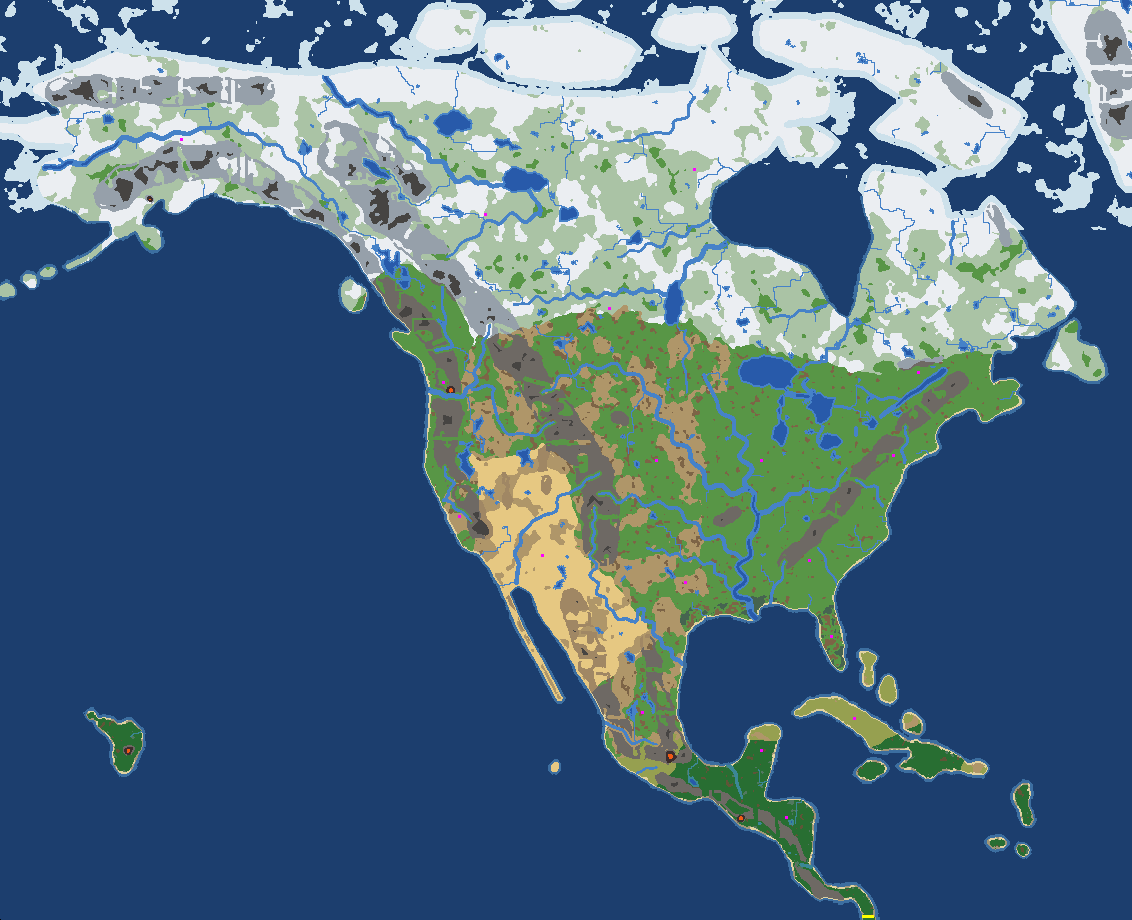
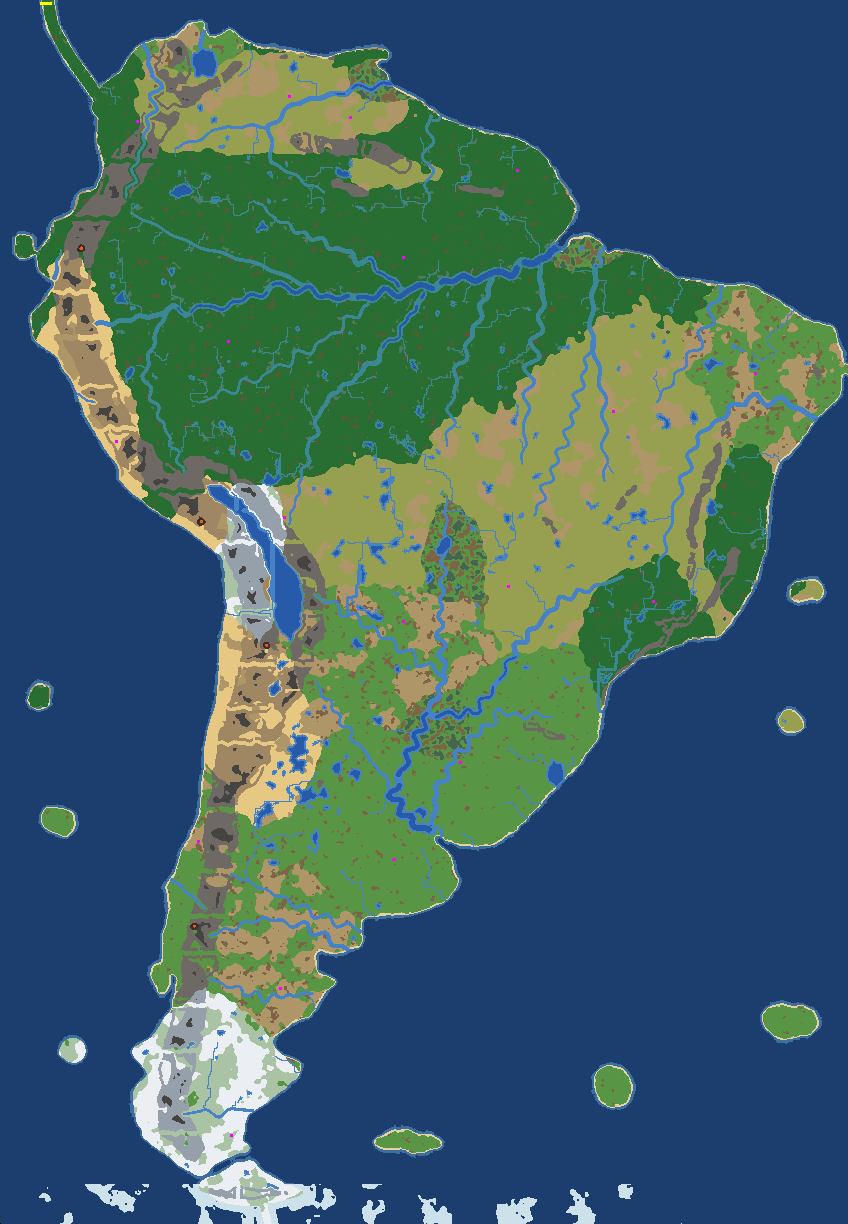
Walking between North and South America
There is no gate or trail post at the isthmus. The land simply runs off the bottom of the North America map and onto the top of the South America map, at a neck 14 tiles wide.
- Walk to the very edge of the map on the isthmus: the bottom edge in North America, the top edge in South America. Wading in the water just beside the neck works too.
- The game asks whether you want to travel on. Say no and you are left alone for 30 seconds.
- Choose to travel. Your character leaves with what they wear and carry, under the same rules as a trail (see What you can take), and the game sends you to the other land’s server. Join it to carry on.
- You come out on the facing edge of the other land, as far along the neck as you were, three tiles in and facing inland. Your home moves with you.
Some things to know:
- You need a BYOND account (not a guest), and you must be awake and not restrained.
- Your wounds come with you. Unlike a trail, you do not need to be at full health to walk across.
- Riders take their mount along if it carries nothing: it stands beside you on the far side, and you get back on. A mount with saddlebags or anything else on it stays behind.
- A led animal follows you. One tame animal you lead by hand, close beside you, crosses with its name and health if nobody rides it and it carries nothing. Wild animals stay behind.
- Hand carts and travois that you pull by hand cross with their load, shut inside. Everything in the load must be something that could travel on its own (the same list as above); if not, the game names what to unload first. A cart hitched behind a horse or carriage must be unhitched and pulled by hand.
- Bicycles. Ride or wheel a bicycle or running bike to the edge: you get off and wheel it across, and it stands beside you on the far side.
- Carriages. Drive the team to the edge and the driver is asked. The carriage crosses with its team in harness (horses or cattle) and the shut crates on its seats; the driver climbs back up on the far side. Passengers must get down and walk across themselves, and anything aboard that cannot travel, such as a barrel or a hitched cart, keeps the carriage on this side.
- Motor vehicles and anything else you drag cannot cross. Get down or let go and walk on.
- If the other land is asleep, your arrival wakes it. If it is stopped, the crossing is closed and the staff are told someone is waiting.
- The crossing is closed for a moment while the world saves.
Hills
Both lands have hills. Light comes from the north-west, so slopes facing north-west are lighter and slopes facing south-east are in shadow. Flat ground, water and beaches are not shaded.
The land follows the map. Beaches and marshes are low and flat, and the ground climbs gently away from the rivers and lakes. The mountain chains rise highest, and the passes through them are the easiest way across.
Hills change how fast you walk:
- Climbing is slow, and each extra level of steepness costs more than the last. A gentle slope of one level per tile takes about half again as long as flat ground, two levels more than twice as long, and the steepest grades about four times as long.
- Going downhill is quick: a gentle slope is about half again as fast as flat ground, and two levels per tile almost twice as fast. Drops steeper than that are picked down more carefully, so they are less of a gain.
- When you hold a direction and slide freely, your pace follows the slope under you smoothly, not one tile at a time. Keep going downhill and you build momentum: you get faster still, and the speed carries you across a few tiles of flat ground and partway up the next rise. Stopping or turning back loses it. With Tap To Step, quick taps feel the slope one tile at a time.
- Steep steps of three levels or more are tiring: scrambling up one spends some stamina, and the game tells you when you scramble up or pick your way down a steep slope.
- Running down a steep drop of three levels or more can trip you. The steeper the drop, the more speed you carry and the more tired you are, the likelier you are to fall. You go down, roll on down the slope while it stays steep and get a few bruises for each tile you roll. Walking down a steep slope is always safe.
For a long trip, going around a big hill can be faster than going over it, and a pass or a gentle inland slope is usually faster than scaling a range from its steep seaward side.
Gaia and the Europe, Jungle, Desert and Asia maps have hills too, and they work the same way.
Built floors and walls level the ground under them. Floors and roads you lay (wood, stone, tiles, dirt roads and the like) are not shaded, and walking onto, off or across them ignores the hill. Grass, dirt, snow, sand, rocky ground, gravel, mined floor and trenches keep it.
Hills also block your view. Ridges, cliffs and plateau edges hide whatever is behind them, so you can’t see past a ridge or onto a plateau well above your eyes. Gentle slopes and small rises don’t: you see over a low rise, though the ground just behind a rise about your own height may be hidden while a person standing there still shows. From high ground you see further down the slopes. Lying down lowers your eyes and hides more. Tall things show over a crest before the ground they stand on, so you may see someone’s head or a treetop beyond a ridge. From high ground you can also see over lower walls, fences and trees into the open ground beyond them; the ground right behind a wall stays hidden, and you never see into a roofed building this way.
Bullets follow the hills too. A ridge between you and your target stops the shot, and a shot fired downhill that misses lands in the ground beyond. From well above them you can fire over lower cover, walls and people in your way, and over the roofs of buildings below you. On level ground cover works as usual. Hostile NPCs follow the same rule: they can’t see you behind a ridge.
On hilly maps bullets also drop with range. Each weapon is sighted for a set distance (rifles about 12 tiles, pistols about 7, shotguns and muskets about 6, bows about 5); beyond it the shot falls lower the further it goes. Where you click on your target sets your aim: click higher on a distant target to hold over, or the shot lands short. Shooting steeply down from high ground is more forgiving.
Tamping paths and grading hills
Craft a stone rammer from 2 stone (Tools, once you have studied Basic Toolmaking). Click bare dirt with it to pound the tile into tamped earth in a few seconds; stronger characters work faster. Tamped earth keeps the shape of the hill, but climbing onto it is about half as hard, and it never turns to mud in the rain. Clear grass with a shovel first, and clear any snow; the rammer will not work on a tile with a crop or a floor on it. A shovel breaks tamped earth back into loose dirt.
To change the ground itself, grade it one level at a time:
- Flatten with the rammer: use the stone rammer on a dirt or tamped-earth tile that is higher than the tile you stand on. After about 10 seconds it is pounded one level lower, stays tamped, and the loose dirt piles up at your feet. Keep ramming until the tile is level with you. On level ground the rammer only tamps.
- Cut with a shovel: use a shovel on disarm intent on dirt or tamped earth. After about 10 seconds the tile is one level lower and you get a pile of dirt on it.
- Fill: put a pile of dirt on a tile and use the stone rammer on it. The dirt is packed in, the tile rises one level and becomes tamped earth. The rammer reminds you to do this when you tamp a spot lower than yours.
Each tile can be dug down or built up by at most two levels from the natural ground, so ridges and cliffs can be eased but not removed. Ground next to water, or with snow, a floor, a crop or anything solid on it, cannot be graded. Levelling an area means planning cuts and fills and carrying dirt from the high spots to the low ones.
What slows you down
Use the Check Movement verb (IC tab) to see what is slowing you and by how much. It lists each cause as a share of your normal step, gives your step time next to an unhindered one, says what the tile under you is and how high it stands, and shows how much each neighbouring tile rises or falls.
The usual causes, roughly from largest to smallest:
- Hunger and thirst. Until your food and water are each over about half full, you are slowed far more than by any gentle hill, and more the emptier you are.
- Hills. Each level you climb in a tile costs more than the last: one level is about half again as slow as flat ground, two levels about twice as slow. Downhill is faster.
- Water, mud and snow. Wading, flood water and flooded trenches are slow. Dirt and grass turn to mud in the rain in most climates. Snow slows you unless you wear snowshoes, and snowshoes are clumsy off the snow.
- Injuries and pain: broken or missing limbs, unsplinted ribs, shock and heavy pain.
- Load and gear: carrying a lot of weight, bulky armour or clothing, shields, a full backpack, wet clothes, or pulling or carrying something.
- Low mood, drowsiness and some traits.
Making a fast path. Tamping and grading make a hill easier, but they never make it flat: tamped earth keeps the hill and only halves the cost of climbing, and grading moves a tile at most two levels. For the fastest path, lay a floor or road over the ground (wood, stone, a dirt road and the like). Built ground counts as level, so walking onto, off or along it ignores the hill, and it never turns to mud. Where you can’t build, tamp the uphill tiles and follow the gentlest slope.
Rivers, floods and the sea
Rivers flow downhill to the sea, and a belt of sea along each coast carries a current. Examine the water to see which way it runs (see Sea currents and swimming). After a long rain or a spring thaw, rivers can rise over their banks and fill the low hollows beside them; Floods covers when that happens and how to keep your home dry.
Weather
Both lands have the usual Nomads seasons and weather, and each area keeps its own climate, from the ice of the far north and the cold cape to the jungle and the deserts.
New here? Your First Day covers getting a research book, food, water and shelter. For general play, see Civilizations & Nomads.