Gaia
Gaia is the authored Nomads map named Nomads (Gaia). Its surface is z=2; z=1 is the underground layer. The underground is solid rock that opens up as you dig (see Digging down); the map images below were drawn before that and show older caves.
Gaia is the mainland of the persistent worlds, one of the regions of the world. New characters start here, and a character who dies without a bed in another land starts again here. It is not in the round map vote.
Getting there
Gaia lies in the Atlantic, across the sea to the east of the Americas and west of Europe and Africa, with Greenland to its north. It is an island, so no walk leads here. Build a ship, bring it near the edge of any other land’s coast and set out on a voyage: Gaia is on the list, about 6 minutes’ sailing from North America and 7 from South America (see Sailing between the continents). You arrive anchored off Gaia’s west coast, and sail back the same way. A plane can fly here too (see Flying to another continent). A trail marked out by players can also lead here once the staff approve it (see Marking out a new trail).
At a glance
| Climate | Every climate, from tundra and taiga to temperate forest, desert, savanna and jungle, across several continents |
| Local time | 2 hours behind the reference time; northern seasons (see Time zones and seasons across the lands) |
| Rich in | Copper. Tin and iron are found at the usual rate, so you can reach bronze and iron here on your own, but there is no bauxite or uranium: later industry needs trade or a foothold in another land (see Each continent’s ores) |
| Farming | Crops grow about a quarter faster than anywhere else (see Farming) |
| Peoples | Gaia has peoples of its own, by climate (see Peoples and Languages) |
| Sieges | Only a Town or City can be besieged here (see Sieges and defence windows) |
Gaia is the best place to settle in and stay alive, but not to reach the last ages alone: oil springs on land run dry here as on most lands, and the late ores lie in other lands.
Map layout
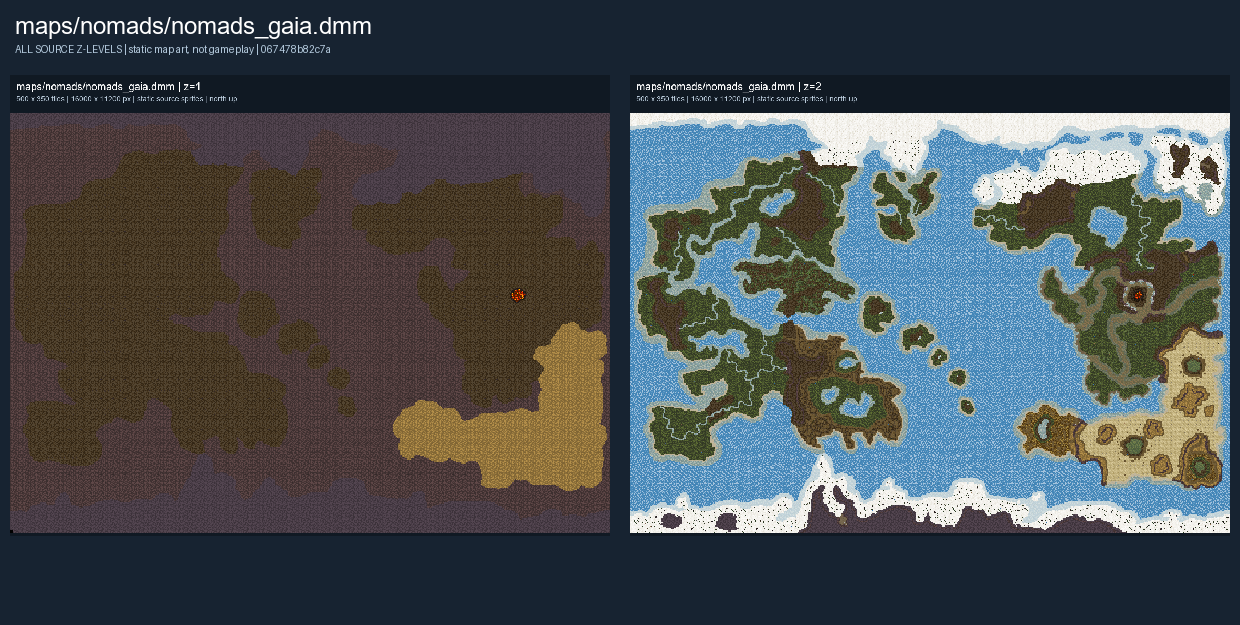
nomads_gaia.dmm. Runtime lighting, generated objects and later sprite changes are not shown.Full-resolution layers: z=1; underground (16,000 x 11,200 PNG) · z=2; surface (16,000 x 11,200 PNG).


What Gaia has that the Americas do not
- A seabed under the deep ocean, so submarines can dive, and aircraft carriers and freighters with a hold below the waterline can be built.
Hills
Gaia’s surface has hills. Soft lines on the ground follow each height level: where the lines sit close together the slope is steep, and where there are none the ground is flat. Light comes from the sun, so slopes facing it are a warm, lighter colour and those facing away are darker, and higher ground casts a shadow away from the sun: long at dawn and dusk, short at noon (see The sun and shadows). Water and beaches are not shaded.
The land follows the map. Beaches and marshes are low and flat, and the coastal plain behind them rolls into gentle hills. The rocky ranges are high plateaus: where a range stands close to the sea its sides are steep, a hard climb of a few tiles, while from inland and through the passes at the ends of a range the climb is long and gentle. Rocky shores can be cliffs, rivers run through gorges with one high bank, the desert’s lakes sit in craters with steep rims, and long ridges cross the larger continents with a steep face on one side and an easy slope on the other.
Walking speed on slopes, tripping, sight lines, bullet drop, tamping paths, grading hills and the Check Movement verb work the same way here as on the Americas: see Hills.
Rivers and floods
Gaia’s rivers rise after long rain and in the spring thaw, and spill onto the low ground beside them, as on the Americas. Cellars and mines near a rising river seep water. See Rivers & Floods.
Weather
Gaia has the same seasons as other Nomads maps, but clear spells last longer: while the sky is clear, rain, snow and storms start only about half as often. Once bad weather has started it runs its usual course.
New here? Your First Day covers getting a research book, food, water and shelter. For the other Nomads layouts, see Nomads Maps. For general play, see Civilizations & Nomads.