Asia
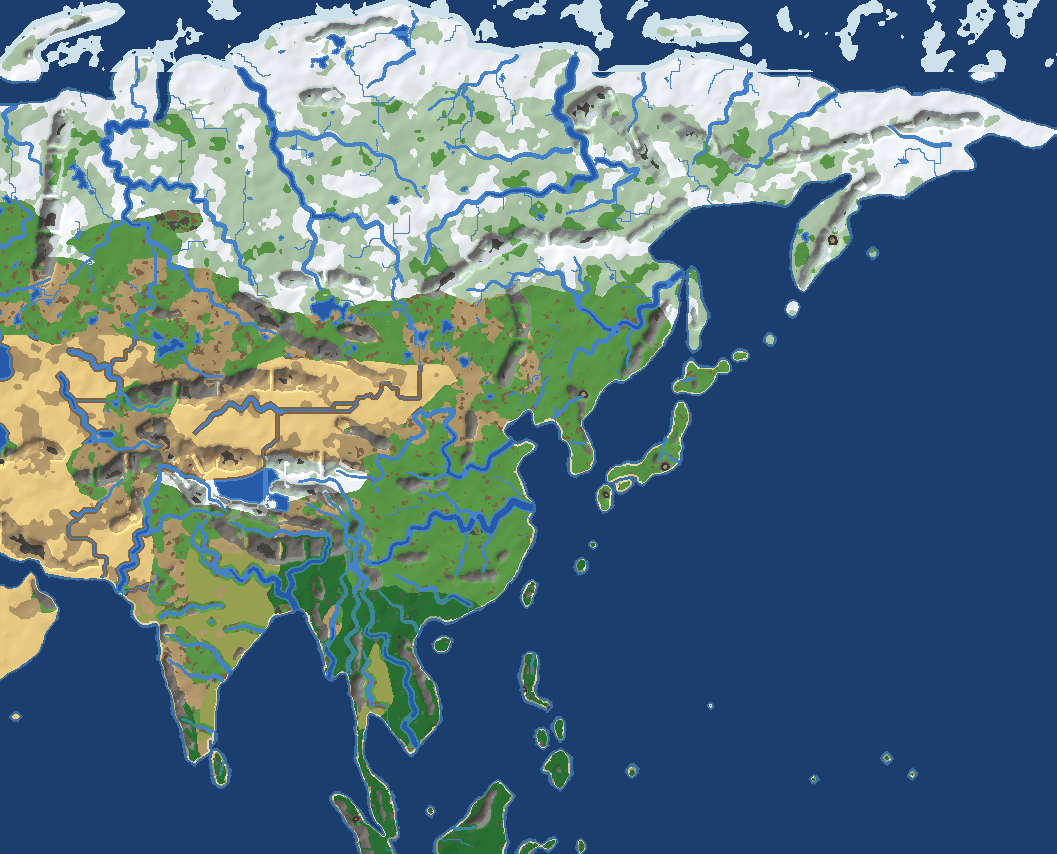
Asia is the largest land of the persistent worlds, drawn after the real continent from the Urals to the far north-east cape: the frozen north, the steppe, the deserts and high plateau of the middle, and the monsoon coasts and jungles of the south and east. It borders three other lands on foot, and its mines hold the saltpeter, silver and gemstones others need.
At a glance
| Climate | Tundra and taiga in the north, steppe, deserts and high mountains in the middle, temperate east, savanna and jungle in the south |
| Local time | 6 hours ahead of the reference time; northern seasons |
| Rich in | Saltpeter, silver, gemstones and diamonds; cinnabar and black iron sand are twice as common too |
| Peoples | Mongols, Koreans, Han, Persians, Yamato and Viet |
| Neighbours | Europe and Africa on foot to the west, Oceania on foot to the south; the other lands by sea or air |
| Coasts | East, south and north |
Getting there
Asia’s west edge joins two lands: its northern part leads to Europe and its southern part to Africa. Its south edge, among the southern islands, leads to Oceania.
- On foot. Walk off Europe’s east edge, Africa’s east edge beyond the desert peninsula, or Oceania’s north edge, and you come out on the matching edge of Asia (see Walking to a neighbouring land).
- By ship. Asia’s coasts face the open sea to the east, south and north (see Sailing between the continents).
- By plane. Fly from any other land (see Flying to another continent).
The land
- The north is a vast belt of taiga with tundra and ice along the Arctic coast.
- The middle is open steppe, sandy deserts and the highest mountains of the world, with a high, cold plateau among them.
- The east is temperate and well watered, with long rivers running down to the sea and islands off the coast.
- The south and south-east are hot savanna and monsoon jungle, broken into peninsulas and island chains.
- Mountains are everywhere in the middle. Mined-out mountain floor keeps giving stone and regrowing ore seams (see Old mountain floor and ore seams).
- No diving. There is no seabed level under the sea, so submarines stay on the surface, and aircraft carriers and freighters with a hold below the waterline need Gaia.
Resources
- Saltpeter, silver, gemstones and diamonds turn up twice as often as usual. Saltpeter makes Asia the place for gunpowder.
- Cinnabar is twice as common (see Mercury), and the rivers and coasts give more black iron sand than other lands (see Tamahagane).
- Silk: Asia is the only one of Earth’s lands where broadleaf trees are mulberries, so silk is raised here (see Resins, Silk & Fabrics).
- Rubber: every living jungle tree is a rubber tree (see Rubber trees).
- Iron is found at the usual rate; other ores are scarcer than usual. Springs of oil on land run dry here, so drill offshore (see Each continent’s ores).
Peoples and languages
Someone born in Asia belongs to the people of the climate they were born in: Mongols (Mongolian) in the tundra, Koreans (Korean) in the taiga, Han (Chinese) in the temperate and dry lands, Persians (Farsi) in the desert, Yamato (Japanese) on the coasts and Viet (Vietnamese) in the jungle and savanna. See Peoples and Languages.