Africa
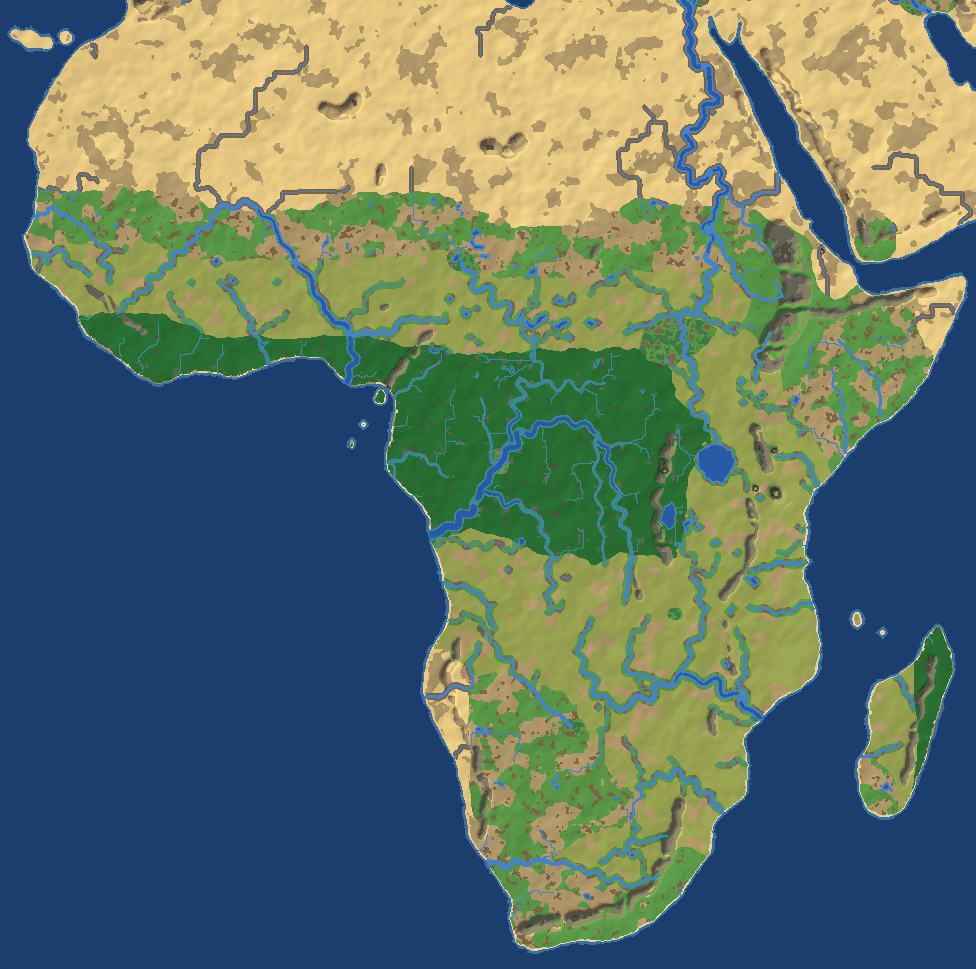
Africa is a land of the persistent worlds drawn after the real continent, from the great desert in the north to the southern cape, with the desert peninsula to its east. It lies across the equator, so most of it is hot all year. It is the only land where oil still flows from springs on dry land, and its jungle is one of the few places that grow rubber.
At a glance
| Climate | Desert in the north and east, savanna, jungle at the equator, temperate at the southern cape |
| Local time | 1 hour ahead of the reference time; wet and dry seasons near the equator |
| Rich in | Sulphur and tin |
| Peoples | Swahili, Zulu, Egyptians and Arabs |
| Neighbours | Asia on foot to the east; the other lands by sea or air |
| Coasts | West, south and east |
Getting there
- On foot from Asia. Walk off the southern part of Asia’s west edge and you come out on Africa’s east edge, beyond the desert peninsula. Walk off that stretch of Africa’s east edge to go back (see Walking to a neighbouring land).
- By ship. Africa’s coasts face the open sea to the west, south and east (see Sailing between the continents).
- By plane. Fly from any other land (see Flying to another continent).
The land
- The great desert covers the north and the peninsula to the east. Days are scorching and nights cold, water is scarce away from the rivers and oases, and sandstorms blow. The fertile banks of the rivers can be ploughed (see Winter & Long Rounds for heat and cold).
- The savanna runs in wide belts north and south of the jungle: open grassland with scattered trees, big herds and the predators that follow them.
- The jungle around the great central river is hot, wet and dense, and its wildlife is dangerous.
- The south is milder, with temperate hills and the mountains of the cape.
- Mountains and lakes line the east, along the great rift. Mined-out mountain floor keeps giving stone and regrowing ore seams (see Old mountain floor and ore seams).
- No diving. There is no seabed level under the sea, so submarines stay on the surface, and aircraft carriers and freighters with a hold below the waterline need Gaia.
Resources
- Sulphur and tin turn up twice as often as usual.
- Oil: petroleum springs on the desert ground of Africa keep flowing. Everywhere else on the continents, springs on land run dry (see Petroleum wells).
- Rubber: every living jungle tree is a rubber tree (see Rubber trees).
- Iron is found at the usual rate. Other ores are scarcer than usual (see Each continent’s ores).
Peoples and languages
Someone born in Africa belongs to the people of the climate they were born in: Swahili (Swahili) in the jungle and savanna, Zulu (Zulu) in the temperate south, Egyptians (Egyptian) in the desert and Arabs (Arabic) in the dry lands and on the coasts. See Peoples and Languages.