Guide to Ranching
For taming dogs, riding horses and driving carriages, see Animals, Dogs & Mounts.
Harvesting dead animals
Use a held sharp tool on an adjacent dead animal. Harm intent performs quick butchering in 30 ticks (normally three seconds); Grab intent skins and butchers in 100 ticks (normally ten seconds). Moving, changing your active hand, becoming incapacitated, disconnecting or losing the corpse/tool cancels. Only one harvesting action can claim a corpse at a time. Successful harvesting removes the corpse.
Both routes give the same meat and food byproducts. Grab selects species pelts; quick Harm butchering gives untanned raw hides for supported mammals. Animals do not provide finished leather. Leather tanning turns raw hides or prepared pelts into leather. Normal meat yield follows size: minuscule 1, tiny 2, small 3, medium 4, large 5, huge 8 separate portions. Existing pig-leg, chicken-carcass, poisonous-frog, crab, zombie and mouse outputs remain distinct.
Butchering trains the hunting skill, and a skilled hunter cuts more food from each carcass. Above 1.0 hunting, every 0.01 adds 1% more meat portions (or pig legs and chicken carcasses) and animal fat: at 1.5 you get about half again as much, and at 2.0 or higher double. Organs, bones, sinew, hides and pelts do not change with skill.
The mammal products below apply to supported cattle, pigs/boars, goats, sheep, deer, bison, camels, rabbits, monkeys, cats, wild bears, wolves, foxes, gorillas, panthers, sabertooths, horses, pet or commanded dogs, mammoths, giant ground sloths and bats. Animal type and interaction handling matter: not every dog or bear follows these rules, and the table does not guarantee that every juvenile can be harvested. Let Y be the size yield above.
| Product | Yield |
|---|---|
| Heart, liver, kidneys, lungs, brain, intestines | One of each when Y is at least 3; smaller mammals give one mixed giblets portion instead |
| Stomach | Cow/pig/goat/sheep processing stomach; other mammals with Y at least 3 give one food stomach |
| Sinew | One stack of Y minus 2, minimum 1 and maximum 4; only when Y is at least 3 |
| Bone | One stack of Y minus 2, minimum 1 |
| Quick-butchering raw hide | One stack of Y minus 2, minimum 1 and maximum 6 |
| Fat | Up to two portions when the animal’s fat rules allow it |
Bone and sinew, with the same yields as the table, also come from larger birds (penguins, turkeys, geese and pelicans) and large reptiles (alligators, constrictor snakes and dinosaurs other than compsognathus). Chicken and rooster give one giblets portion instead, and small birds such as crows, gulls and pigeons give neither. Other nonmammals do not gain mammal offal or fat; existing reptile pelts remain available. Adult male and female turkeys each provide 1 raw hide piece through either harvesting route; turkey chicks provide no hide. Pelts depend on species: lions give 3, gladiator lions give none, and non-white sabertooths give 6. White wolves and giant gorillas retain their special pelts.
Keep species pelts for their existing fur clothing and pelt recipes, or scrape one pelt piece to start tanning. Each processed piece yields 1 leather sheet; tanning does not multiply a piece into several sheets.
Offal is raw, decaying food, not a surgical transplant organ. Each portion starts with 2 protein and accepts existing meat processing. Cow, pig, goat and sheep stomachs retain their sausage/rennet uses. See Cooking for preparation and preservation.
Sinew and primitive tools
Activate sinew in hand to consume 1 sinew and make 1 rope named sinew binding cord. It works in existing rope recipes, including nets, leashes and bindings, with their existing recipe costs and era gates. Sinew stacks hold at most 20.
Sharpen a branch with an edged tool; this takes 80 ticks and produces a sharpened stick. Gather flint from rocks with Grab intent, then strike a rock with it until sharpened.
To assemble a flint axe, use a held sharpened flint on a sharpened stick held by you or on your tile. Keep 1 sinew or rope in your inventory or on that same tile. The 100-tick action consumes the stick, head and one binding for one axe; cancellation leaves inputs unspent. Other stone and bone stack recipes remain available.
Livestock
Well, from the very start of the Neolithic age, Humanity has started domesticating animals.
| Animal | Image | Description |
|---|---|---|
| Chicken |

|
A bird great for laying eggs. |
| Pig |

|
Good for manure and meat. |
| Sheep |

|
These animals are quite valuable as they can be sheared to drop wool. |
| Cow |

|
Highly valuable as they give milk, which doesn't need to be purified or pasteurized at all. They can also breed in a 5x5 cage. |
| Horse |

|
Extremely valuable. You can ride these animals or kill them (discouraged as these are rare) |
| Camel |

|
Just like horses but you can't ride them, Put a bag on their back to carry equipment |
| Goat |

|
Much like the cow, goats can be milked if female. |
| Turkey |

|
A bird great for laying eggs! |
Taming wild animals
Cattle, goats, sheep and pigs born in the wild are wild. A wild animal will not let you leash, milk, shear, saddle, harness or plough with it until it trusts you. Examine an animal to see whether it is wild or tame.
- Tame it by feeding it by hand, again and again: grain, seeds or anything it eats. It takes 6 feedings, each at least 10 minutes after the last. Feeding it more often does not speed it up.
- Its trust fades by one feeding for every full day you leave it unfed.
- Young born beside a wild mother of their kind are wild too, so tame your breeding stock first.
- A leash can be made from the first age on, so you can lead your tamed herd home.
Feeding
Grazing animals (cows, bison, goats, sheep, horses and the like) get hungry, graze grass and eat loose grain. You can also feed them wheat, oats, barley or rice by hand. Bison need pasture or grain just like cows, and bison cows can be milked the same way.
Hens and turkey hens lay a limited number of eggs. Feeding seeds to a hen that has stopped laying gives her more eggs.
How well an animal is fed sets how much it produces. A well-fed cow, goat, sheep, pig or bison refills its milk at the full rate, a hungry one (one that is wandering off to look for food) at half the rate, and a starving one gives no milk at all. Hens lay the same way: every time when fed, about half as often when hungry, and not at all when starving. Keep pasture, grain or hay in reach to keep a herd productive.
Hay
Hay is stored fodder for when there is no grass to graze, such as in winter or in a pen.
- Making hay: cut grass with sharpened flint or any sharp knife to get grass cuttings. Tall grass also gives way to other sharp tools. With the cuttings in hand, click open ground next to you to spread up to 20 portions there to dry. After 3 minutes of dry weather, they turn into the same amount of hay. Rain or snow under open sky stops the drying, but grass under a roof or indoors keeps drying. Adding more cuttings to the pile starts the drying over. Picking the pile up by hand gives back the cuttings.
- Feeding: use hay on a hungry cow, goat, sheep, bison or other grazer to feed it one portion. Grazers also eat hay lying next to them.
- Hay bales: use 10 hay in hand and choose Tie a hay bale. The bale is placed in front of you. It holds 10 portions and blocks movement. Animals standing next to it eat from it, and hungry grazers with no grass within 6 tiles walk over to it. Pull hay off a bale by hand, or add hay to refill it. An empty bale disappears.
- Thatch roofing: use 2 hay in hand and choose Bundle thatch roofing. This needs the same knowledge as thatch roofing made from leaves.
Reproduction
To simply get these animals to multiply, you have to have them in a fairly small area and cramp them. For cows you need a bull and a cow cramped in a fairly small area and they’ll eventually get to it. Chickens just need at least 2 and one needs to lay an egg and be sitting on top of it for awhile. Try customizing your chicken coops making it so they are unable to move off their egg.(Only the cows, chickens, Deers, Pigs, Sheep, Goats and turkey’s can breed for now)
Bison cows keep together: when one of them is hurt, the cows around it bolt away from the hunters. Bulls stand their ground. Plan a bison hunt with the herd running in mind.
Every breeding species has a population cap, so herds and wild packs stop growing once there are enough of them on the map. Wolves stop breeding at 20 and bears at 12; cows, deer and bison at 30; goats, sheep and turkeys at 35; chickens at 50.
While nobody is connected to a world, its animals wait: they don’t move, get hungry or attack until a player joins, so livestock left alone overnight is still fed and in place.
Wildlife
| Animal | Image | Description |
|---|---|---|
| Crab |

|
Crabby snappy, watch out for its arms. |
| Wolf |

|
Seen in temperate and tundra, they go in packs most of the time. |
| Goose |

|
Geese always mark their territory. |
| Panther |

|
The assassins of the jungle, hunt with caution. |
| Jaguar |

|
Fastest hunters in the game. |
| Boa |

|
It can strangle anyone to death. |
| Mammoth |
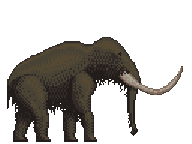
|
A colossal behemoth, towering over huts and houses. If one thinks of hunting alone one of these, they'll find themselves stomped, their gibs all over the place. |
| Cobra |

|
An aggressive cobra will jump and bite you if you approach it. |
| Crow |

|
Flies around towns giving everyone the frights. *caw caw*. |
| Buffalo |

|
Hyper-aggressive buffalos, don't try going near them. |
| Mouse |

|
*Bites you* O-oh I spread you m-my plague, sowwy uwu. |
| Penguin |

|
Found around the northern hemisphere, mostly at coasts. |
| Bear |

|
Bears roam the temperate, run away if you have no weapon. |
| Alligator |

|
A fierce beast that roams the swamp. If you have no weapon you should run because you can't kill these with your hand. Faster in the rain. |
| Deer |

|
These animals will run away from you when they see you! Try making them run into a corner to kill them. |
| Snake |

|
A slithery serpent that feasts among small mice; Though it is cute, touching it isn't the best idea. |
| Frog |

|
Drops 1 meat. Watch out though if the frog is poisonous it can kill you! Other than that it just eats flies. Frogs are small enough that people and larger animals walk straight over them. |
| Poisonous Frog |

|
A poisonous creature, it is the cousin of the normal frog, however, eating it will leave the taste of death in your mouth! |
Bugs
| Insect | Image | Description |
|---|---|---|
| Flies |

|
An annoying pest that will buzz around any food you leave out, so stay clean! |
| Mosquitos |

|
These fly like creatures give you malaria, stay away from them. If you do get bit by them, don't worry there's Quinine that cures malaria in swamp regions. |
| Locusts |
|
Ready to eat your crops, ready to molest that corn. Hide your cabbage, hide your wheat, locusts are here to swindle your meat. |
| Cockroach |

|
Penisbeetle for the friends. |
| Leech |

|
Completely harmless unless they gang up on you, human boy. Can be used in medicine as a method to suck blood out. |